

First, look at what happened
Every download keeps a log of its recent events: retries, redirects, the server's answers and errors.
- Hover over the download's Status in the list to see them.
- Or open its progress window (double-click an unfinished download). The connection table shows what each connection is doing, and Retrying with the reason when one fails.
- File Properties (Alt+Enter) shows Last try and its Result.
A download says Error
- Read the reason (hover over Status).
- Select the download and click Resume. Many errors are a server or connection having a bad moment.
- If the link has expired (common for links from sites you sign in to, or links with a time limit in them), get a new one: right-click → Refresh download address. See Resume a broken download.
- If it says the file changed on the server, the file isn't the one GDM started with. Right-click → Redownload to start again from the beginning.
- If it says Google Drive won't give this file now, Drive's download limit for that file was reached. See Google Drive links.
A download starts over instead of resuming
- Look at Resume capability in the progress window. No means the server can't send a file in parts, so GDM can't continue it later.
- Some servers report a new date for the same file every time. Tick Options → Downloads → Ignore file modification time changes when resuming a download.
Downloads are slow
- Check that the Speed Limiter is off: Downloads → Speed Limiter → Turn off. Also look at Downloads → Speed Limiter → Settings... → Limit all downloads together to, which applies even with the limiter off.
- Check the download's own Speed Limiter tab in its progress window.
- Check Options → Connection. A low Default max. conn. number, or an exception for the server, means fewer connections. Rows marked (auto) are servers that refused more connections; GDM can't do more there.
- Check Download limits in the Scheduler. When the limit is reached, downloads wait with Waiting: the download limit is reached (Scheduler).
The browser doesn't send downloads to GDM
- Was GDM installed with the setup, with Set up browser integration ticked? A portable copy can't take browser downloads. Run the setup again to add it.
- Is the extension loaded and turned on? Look for GolinksPRO Download Manager on the browser's extensions page. In Firefox, install it from addons.mozilla.org: a temporary add-on is gone after a restart. See Browser integration.
- Is Options → General → Use advanced browser integration on, and your browser ticked under Capture downloads from the following browsers?
- Is the file's type in Options → File types? Only listed types are taken automatically. Download with GolinksPRO Download Manager on the right-click menu takes any link.
- Is the site in Don't start downloading automatically from the following sites?
When none of this helps, the browser keeps the download, so nothing is lost. The extension's toolbar button says why it couldn't reach GDM; see The browser and GDM aren't connected.
The Scheduler didn't start the queue
- GDM must be running at that time. Closing the window is fine (it stays in the tray); Tasks → Exit is not.
- Did you click Apply after setting the time?
- Daily starts only on the ticked days. Once at starts only on that date.
- A computer that is asleep doesn't run anything until it wakes, unless the queue has Wake the computer to run this queue ticked (on Windows it needs Allow wake timers in the power plan; the Scheduler says when it's off). See Wake the computer to run a queue.
A video won't download
See If a video won't download.
A magnet link takes a long time
A magnet link has to get the torrent's file list from other peers first. That can take a minute or two, and longer for torrents with few peers. If nobody answers in about three minutes, GDM gives up; try again later, or use the .torrent file if the site offers one.
GDM uses a lot of memory
Task Manager shows several figures, and they mean different things:
- Memory (on the Processes tab) is what GDM holds for itself alone, its private working set. With the window open and nothing downloading, that is about 70 MB.
- Working set (Details tab, add the column) adds memory shared with other programs. GDM draws its windows with the graphics card, so the graphics driver's memory counts here too, about 120 MB in all.
- Commit size is memory GDM has reserved, whether in use or not.
Closed to the notification area, GDM gives its memory back to Windows: Memory drops to under 10 MB within seconds and stays low while it waits. Downloads, queues and the scheduler go on as before. The list of every language (View → Language) loads fonts for every script while it's open; GDM lets them go when it closes.
The text is too small or blurry
GDM keeps Internet Download Manager's compact sizes. On a large or high-resolution screen, choose View → Interface size (125 %, 150 %, 175 % or 200 %), or press Ctrl + and Ctrl − in any GDM window, as in a browser; Ctrl 0 goes back to 100 %. Every window follows at once, and GDM starts at that size next time. It comes on top of Windows' own display scale (Settings → System → Display → Scale).
A window larger than the screen at that size (Options at 200 % on a 1366 × 768 screen) opens as large as the screen allows, and the rest scrolls: with the scroll bars, the mouse wheel, or Tab to the next control.
GDM tells Windows it draws for each monitor's own scale, so Windows never stretches its windows into blur, and it draws Windows' fonts grid-fitted to whole pixels. If the text still looks blurred, tell us your screen's resolution and Windows' display scale when you report it.
The window freezes or draws wrongly
On Windows, GDM draws its windows with Direct3D 12; on Linux and macOS, with OpenGL, or with Vulkan (Linux) or Metal (macOS) when you choose them. A graphics driver can still misbehave: a window that holds still for seconds, flickers, or shows wrong colours or blocks. Try the other one: choose View → Draw with → OpenGL (or Direct3D, Vulkan, Metal), then quit GDM (Tasks → Exit) and start it again. Choosing the first one goes back the same way.
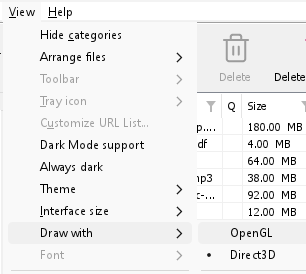
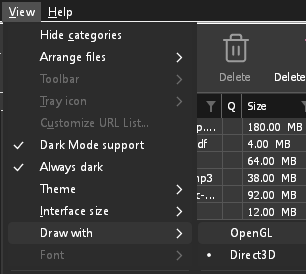
- If Direct3D, Vulkan or Metal can't start on your computer (no driver for it, some virtual machines), or its first window doesn't show within 10 seconds of its own (the time GDM spends loading your list and its icons doesn't count, however slow the computer is just after it starts), GDM draws with OpenGL, and View → Draw with says so and why. Choosing it again tries it again at the next start.
- On Linux, Vulkan needs your graphics card's Vulkan driver: Mesa's (
mesa-vulkan-driverson Ubuntu and Debian,vulkan-radeonorvulkan-intelon Arch) for AMD and Intel, NVIDIA's own driver for NVIDIA. - If neither can start, GDM draws with a software renderer (Microsoft's on Windows, Mesa's on Linux), so the window still opens (Remote Desktop, a virtual machine without a graphics driver). It works, but keeps the processor busier.
- If the graphics card is reset while GDM runs (a driver update), GDM starts again by itself. Lost twice in 10 minutes, it goes back to OpenGL, and View → Draw with says why.
- Updating the graphics driver from the card maker's site (Intel, AMD or NVIDIA) fixes many of these problems.
- A freeze whose report shows the window thread inside the graphics driver as it shows a frame (
ig4icd64.dllorig9icd64.dllfor Intel,nvoglv64.dllfor NVIDIA,atio6axx.dllfor AMD, underopengl32.dll) is the driver's OpenGL stuck, not GDM: on Windows, choose View → Draw with → Direct3D (the default) and restart GDM, and update the graphics driver. If Draw with says Direct3D didn't start there, the line under it says why. - A freeze or crash report says which one was drawing, on which graphics card and driver, and why that one (chosen, the default, or the other one failing), on its
Drawing with:line near the top: include it when you report a problem. A freeze report also says whether GDM was busy, waiting, or hardly ran at all (a computer too busy to run it); see Crash reports.
The setup or GDM won't start
- If Windows says Windows protected your PC, click More info, check that the file is
MisterDownloadManager-<version>-setup.exefrom the Releases page, then click Run anyway. - GDM runs only once. Starting it again brings the running copy's window to the front. If nothing appears, look for GDM's icon in the notification area.
- Linux, from the AppImage or the tar.gz: if the system lacks a library GDM's window needs (such as
libxkbcommon-x11), GDM names it on the terminal and in a message box, with the command that installs it (sudo apt install libxkbcommon-x11-0, or your distribution's). The .deb and .rpm bring these libraries themselves. In a Wayland session GDM opens its window on Wayland instead. - Linux, the first start is slow: GDM looks up the system's fonts for every script once, all together, while it starts (fontconfig); a first start on a busy computer can take a few seconds more. Install your distribution's Noto fonts if some scripts or symbols show as boxes.
My antivirus or VirusTotal flags GDM
A few antivirus programs flag new installers just because they have rarely seen them, and machine-learning engines do this the most. On VirusTotal, a handful of small engines flagging a new setup while the big ones stay clean is usually a false positive. We report these to the vendors when we see them.
To check that your copy is the real one:
- Download GDM only from the website or GitHub Releases.
- Get your file's SHA-256. On Windows, run
certutil -hashfile "MisterDownloadManager-0.5.0-setup.exe" SHA256; on Linux,sha256sumand the file's name. - Compare it with the same file's line in that release's
SHA256SUMS.txt.
If they match, it is the file we published. Every release is built on GitHub from the public source code, so anyone can read what went into it.
If your antivirus quarantined GDM, restore it and add an exception for its folder. If it flags something other than the setup or GDM's own programs, or a copy from anywhere else, don't run it, and please tell us.
HTTPS downloads fail with "no certificates" (Linux)
A minimal Linux system (often with the AppImage, the tar.gz or a build from source) may have no CA certificates, which GDM needs to check a secure server. Plain http:// and ftp:// downloads still work; each https:// or ftps:// one stops at once saying the computer has no certificates to check the server with. Install the ca-certificates package (sudo apt install ca-certificates, sudo dnf install ca-certificates), then resume the download. The .deb and .rpm bring it.
Where your data is
- Installed or the plain zip:
%APPDATA%\misterdownloadmanager. The list and settings are indownloads.json. - Portable: the
datafolder next tomisterdownloadmanager.exe. - Linux:
~/.local/share/misterdownloadmanager; a Mac:~/Library/Application Support/misterdownloadmanager. - Passwords (Sites Logins, the proxy, debrid accounts) are in the system's keychain, not in
downloads.json; see Options → Sites Logins.
To back up your list, quit GDM (Tasks → Exit) and copy downloads.json.
Updates
Help → Check for updates... tells you whether a newer version is out, and what is new in it. Check for updates at every start in that window lets GDM look by itself: a few seconds after it starts, and once a day while it stays open. When there's a new version, its window opens in front.
When there is one, Update now downloads it, checks it, puts it in place and restarts GDM; your list, settings and downloads stay as they are:
| You installed | What Update now does |
|---|---|
| Windows, the setup | Runs the new setup without its windows. An installation for all users asks for the administrator's permission. |
| Windows, the portable or plain zip | Replaces the programs in their folder (a portable copy's data folder is kept). |
| Mac | Replaces the app in Applications. |
| Linux, the AppImage or the .tar.gz | Replaces the AppImage, or the programs in their folder. |
| Linux, the .deb or .rpm | Opens the checked package in your system's package installer, which asks for your password. |
| Linux, another package manager's package (pacman, ...) | Nothing: the window says so, and your system's updates bring the new version. |
GDM installs an update only when the release's list of checksums is signed by GDM's release key and the file matches it; anything else is refused, and Download opens the Releases page instead. Updating this way starts with version 0.2.1: earlier versions open the Releases page.
The AppImage can also be updated by AppImage tools (AppImageLauncher, Gear Lever, AppImageUpdate): it carries the address of its updates, and each release has its .AppImage.zsync file, so those tools download only the parts that changed. This starts with the AppImage of the version after 0.2.4.
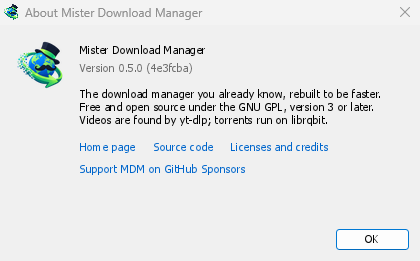
Help → About GolinksPRO Download Manager shows the version you have.
Reporting a problem
Choose Help → Report a problem. It opens the bug report form on GitHub with your GDM version, your system and its version, how GDM was installed and its interface language already filled in. Describe what happened, what you expected and the steps that make it happen. For a download, include the address if you can share it, and the reason shown under Status.
You can also open the form yourself; it asks for the same details.
Next steps
Free, open source, no ads, no trial.
Download GolinksPRO Download Manager